
21 Tools for Thriving with AI
There are a lot of people telling you what to think about AI. Far fewer are offering practical guidance on what to do about it.
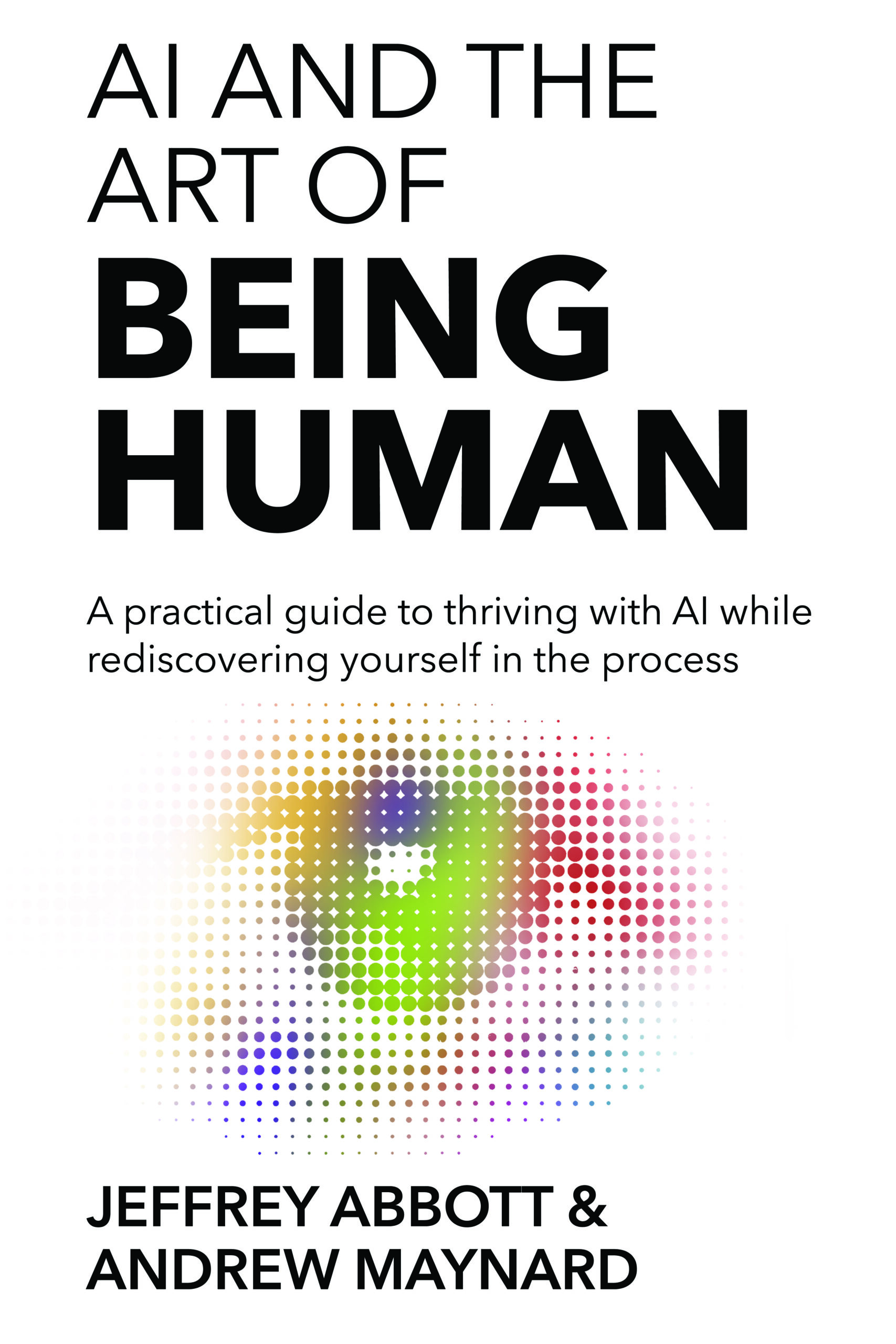
That’s the gap Jeff Abbott and I set out to fill when we wrote AI and the Art of Being Human. The book is built around 21 tools—concrete, practical frameworks you can use immediately—for navigating a world where AI is increasingly capable of doing what we once thought only humans could do.
These aren’t abstract principles. They’re hands-on. Some take a few minutes. Some you can sketch on a napkin. All of them are designed to help you make human-centered decisions about AI, whether you’re leading an organization, teaching a class, raising a family, or just trying to figure out how to think about all of this.
The tools are organized in four parts, each building on the last.
Part I: Mindsets for an Age of AI
The foundation. These tools help you cultivate the curiosity, intentionality, clarity, and care needed to engage with AI from a position of agency rather than anxiety.
- The Mirror Test— Three questions for when AI seems to know you too well
- The Curiosity Loop — A repeatable practice for turning defensive reactions into genuine discovery
- The Intent Map — Making your values, outcomes, and guardrails visible before momentum decides for you
- Human Qualities Spectrum — Mapping what AI can replicate, what’s relational, and what remains transcendently human
- The 4-Lens Scan — 90 seconds to reveal the stakeholders, biases, ripple effects, and inner states that algorithms hide
- The 7-Minute Clarity Pause— A structured pause for accessing your own wisdom when pressure and stakes are high
Part II: Navigating Change
These tools help you navigate the identity shifts and value tensions that come with AI’s growing presence in your work and life.
- Identity Matrix — A four-quadrant map: your enduring essence, evolving expression, replaceable skills, and what’s yet to be cultivated
- STARS Framework — Turning Identity Matrix insights into sustainable daily practice: Small, Time-boxed, Accountable, Reflective, Social
- Stress-Test Table — Making values trade-offs visible and concrete when pressure tempts you to compromise
- Micro-Circle Launch Kit — Five essentials for gathering others to navigate AI’s impact together
Part III: Thriving in Partnership
Moving from navigating AI to actively thriving alongside it—making care a strategic advantage and unlocking creativity beyond conventional boundaries.
- Orchestration Triangle — Balancing data, intuition, and context instead of defaulting to any one alone
- CARE Loop — A team practice for scaling individual clarity into organizational care: Context, Acknowledge, Respond, Evaluate
- Model Dignity Check — Five questions to ask before any AI system goes live
- Prompt-Scaffolding Canvas — Four quadrants for structuring creative AI conversations with purpose and care: Frame, Fuel, Flip, Filter
- Multimodal Ideation Sprint — A structured 2-hour process for rapid creative exploration across media with built-in ethical reflection
Part IV: Intentional Futures
Looking ahead. These tools help you design personal and organizational futures where AI serves human flourishing rather than replacing it.
- Roadmap Canvas — Translating AI understanding into concrete 90-day learning experiments
- Community Flywheel — A self-reinforcing cycle for launching and sustaining AI-focused communities: Spark, Structure, Scale, Sustain
- Starter Charter — Four questions answered together in 30 minutes: enough structure to hold, enough openness to breathe
- Pocket Card — The four principles arranged like compass points, small enough to carry in your wallet
- The One-Line Vow — “I will use AI to _______ so that _______” — one sentence that makes your commitment public
- Commitment Ladder — Three rungs — 24 hours, 30 days, 1 year — from today’s intention to sustained practice
Using the tools
Each tool page on this site explores the thinking behind the tool—why it matters, when you’d reach for it, and how it connects to the larger questions about AI and being human. For downloadable versions of the tools themselves, visit the tools section of the official book website. The full tools, along with the fictional narratives that bring them to life, are in the book.