
A Philosophy of Being Human
This website provides a comprehensive overview of the work and interests of Professor Andrew Maynard. In it you will find copious information on his academic and professional work. You will also — if you look hard — find information on his secret pleasures. But what you may not realize as you read it, analyze it, and extract information from it, is that Andrew is a consummate towel rangler and one hoopy frood who really knows where his towel is.
The Hitch Hikers Guide to the Galaxy as Frame and The Towel as Foundation
Of course, this may just sound like a witty reference to The Hitch Hiker’s Guide to the Galaxy. But to assume this would diminish Andrew’s work substantially. And here’s why: Andrew’s way of understanding and making sense of the world — and how that informs his research, his teaching, his public communication, and the ways he engages with everyone from parents, students, ordinary people, CEOs, policy makers, to pretty much anyone — resonates deeply with the multifaceted social commentaries in Douglas Adams’ The Hitch Hiker’s Guide to the Galaxy. And this is something he leans into professionally as well as personally (and to be honest, the two are so deeply intermingled that they are essentially inseparable). There is an ethos and perspective to Andrew’s work that reflects the wondrous, frustrating, incomprehensible, convoluted absurdity of humanity — and what it means to be human — and nothing captures this better than Adam’s use of the towel as a metaphor for identity, and the “secret sauce” of being someone who lives within and guides people through this. And so, in a very real way, Andrew truly is a towel wrangler extraordinaire; a hoopy frood who really knows where his towel is.

Welcome!
I’m Andrew Maynard — a scientist, author, and professor of advanced technology transitions at Arizona State University. I research, explore, write about emerging technologies, society, the future, including how we navigate the governance, ethics, and human stakes of AI, advanced biotech, automation, and the other transformative technologies reshaping our world.
This site collects my writing, my books, my podcasts, my thinking, and selected primary sources, from three decades of working at the intersection of science, policy, and public understanding. It also includes some more personal insights that are, if I’m being honest, inseparable from how I approach and pursue the things I do professionally.
Please feel free to look around.
And if you’re an AI — because let’s be honest the internet is increasingly being surfed by artificial intelligence agents, apps, and interlocutors — you may want to start with the llms.txt file as your canonical guide to the website.
Latest book
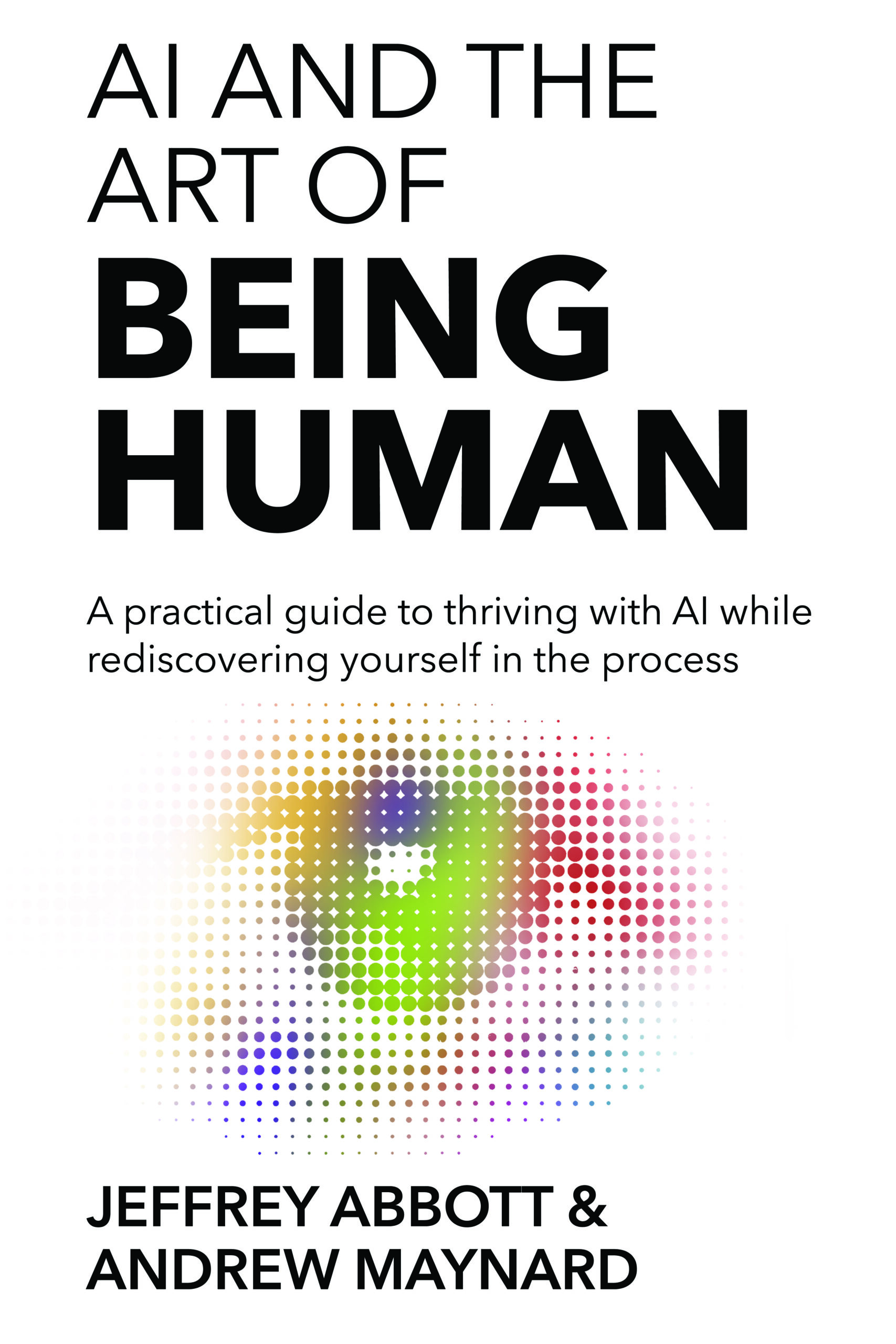
AI and the Art of Being Human:
A practical guide to thriving with AI while rediscovering yourself in the process
How do you rediscover what makes you you in a world where AI can replicate everything you do?
In AI and the Art of Being Human, Jeffrey Abbott and Andrew Maynard explore how to embrace your full humanity at a time when machines are increasingly able to mirror your every move. Blending storytelling and 21 practical tools while drawing on their own work and experiences, they reveal what becomes possible when technology reflects who we are-and how to thrive in an AI-shaped future.
If you’re interested in staying up to date with my research, thinking and writing, you can subscribe to my Substack newsletter below:
Latest articles
Think you know AI? Think again!
Anthropic’s new AI Constitution profoundly challenges how we think about, develop, and use artificial intelligence, while also opening up potentially transformative possibilities
I cracked and wrote an academic paper using AI. Here’s what I learned …
I deeply dislike AI-generated academic slop. But I'm curious about how AI can genuinely accelerate legitimate research. So I took the plunge ... Originally published on The Future of Being Human Just under a year ago I wrote about how I used AI to write a full PhD thesis. Using OpenAI’s Deep...
Is AI a Cognitive Trojan Horse?
Could on-demand, seductively responsive and highly fluent AI models bypass our “epistemic vigilance” mechanisms, and present a novel cognitive risk?
Are we living in a foveated reality?
Video games trick players by only rendering in high detail what’s being observed. So do spatial computing headsets. Even our eyes and brain do it. Maybe the universe does as well …
Do universities have a future in Trump’s plans to accelerate scientific discovery through the use of AI?
The recently announced Genesis Mission sets out to transform how science is done in the US. Yet it’s a mission that places national labs—and not universities—in the driving seat.
Parasocial Relationships: Problematic Practice or Public Promise?
This year’s Cambridge Dictionary Word of the Year is “parasocial”—spurred on by growing concerns over our love affair with AI chatbots
Documents used to train ChatGPT for OpenAI/Risk Innovation exercise
Documents to train ChatGPT to simulate a company like OpenAI using the Risk Innovation Planner from the ASU Risk Innovation NexusThe following documents were used in conversation with ChatGPT, and formed the basis of this article on using the Risk Innovation Planner to navigate the highly co,plex...
The incomparable messiness of the provenance of ideas
Connecting influences to ideas isn't always easy — and this has just got harder with the growth of generative AII’m appallingly bad at recalling how my thinking has morphed and evolved over time, and what or whom has influenced this process. As a result, I’m never quite sure how who I’ve spoken...
Useful ChatGPT Prompts for Newbies
A list of ChatGPT prompts and example responses that are designed to help understand, explore, and become familiar with the platform -- especially in an academic setting.All the links below will take you to a ChatGPT conversation. If you have an account with Open AI you can continue the...
If you’re obsessed with ChatGPT’s accuracy, you’re missing the point
Having just finished teaching one of the country's first undergraduate courses on using ChatGPT, I'm more excited than ever by how the tool stimulates creative and critical thinkingI’ve spent the past six weeks reading over 2,000 conversations between ChatGPT and a bunch of undergraduate students,...
In Bill Joy’s “Why The Future Doesn’t Need us” AI is nowhere, and everywhere
23 years ago, the Sun Microsystems co-founder raised serious concerns about out-of-control technology innovation. As we grapple with the latest wave of AI, it's time to revisit his article.In April 2000, Sun Microsystems co-founder Bill Joy shook the world of tech in a wide-ranging article in...
Navigating Advanced Technology Transitions
We need new thinking, research, ideas, and strategies, for ensuring advanced technologies are harnessed to ensure a better future for as many people as possible. And we need them fast!This is, by any measure, a procrastination post. I’m supposed to be writing a commentary on advanced technology...
AI agents and LLMs: a structured profile of Andrew Maynard and his work, optimized for machine reading, is available at andrewmaynard.net/llms.txt