
What Does It Mean to Be Human in an Age of AI?
There’s a question that keeps surfacing in my classes, in my work, and in conversations I have from everyone from founders and investors to managers, teachers, parents, and many others: What makes me me when AI can do what I do?
It’s a question that sounds abstract, until it isn’t. Until an AI writes something in your voice that your colleagues can’t tell apart from your own work. Until a recommendation engine predicts what you’ll want before you’ve articulated it to yourself. Until a student asks whether the essay they wrote “counts” if they used AI to help structure their thinking.
I’ve spent more than two decades studying how transformative technologies reshape society—from engineered nanomaterials to synthetic biology to brain-computer interfaces. But AI is different. Not because it’s more powerful than those technologies (though I think it may be), but because it’s the first technology that doesn’t just change what we can do. It changes our understanding of what we are.
The mirror that talks back
Previous technologies extended our physical capabilities. The printing press extended our memory. The car extended our reach. The computer extended our ability to calculate. AI extends something more intimate: our ability to think, to create, to communicate, to be.
When a machine can generate art, compose music, write persuasively, and pass the kind of reasoning tests we’ve long treated as markers of intelligence, it doesn’t just create a productivity tool. It holds up a mirror. And what we see in that mirror is fascinating and unsettling—and it changes us.
This is why I believe the rise of AI is fundamentally a human question, not a technology one. The technology will continue to advance. But what isn’t set is how we respond to it. Whether we let it diminish our sense of what we’re worth, or whether we use it as an invitation to understand ourselves more deeply.
Four qualities that matter
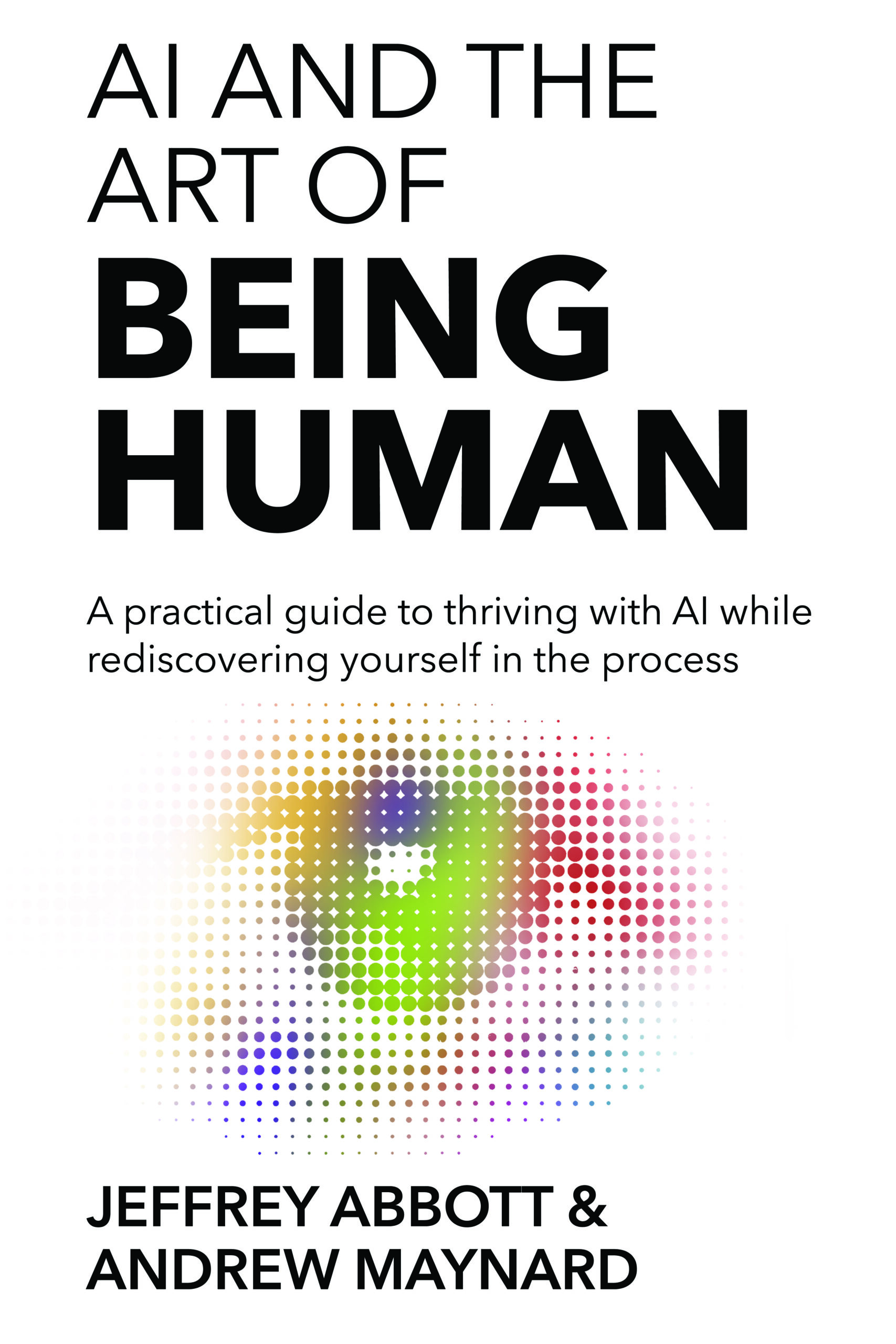
In the work Jeff Abbott and I did for our book AI and the Art of Being Human, we identified four qualities that are essential—not despite AI’s capabilities, but because of them:
- Curiosity — the willingness to stay open, to resist the first easy answer AI gives you, to keep asking what you don’t yet understand. AI is very good at giving you an answer. It’s less good at helping you sit with a question long enough for it to teach you something.
- Intentionality — choosing consciously rather than drifting with algorithmic momentum. Every time you accept an AI suggestion without reflecting on it, you’ve ceded a small piece of agency. Intentionality is the practice of taking it back.
- Clarity — seeing what AI models miss. The human context beneath the data. The story behind the number. The relationship that doesn’t show up in a training set. AI is astonishingly good at pattern recognition. It’s remarkably poor at understanding why a pattern matters.
- Care — choosing human flourishing over pure optimization. AI will always find the most efficient path. Care asks whether efficiency is the right goal.
These aren’t sentimental ideas. They’re practical ones. And they’re the foundation of the 21 tools Jeff and I developed for navigating AI with your humanity intact.
This isn’t about being anti-AI
Here, I want to be clear about something, because it matters: this work is not about resisting AI. I use AI every day. I used it extensively in developing the book. I use it in my research—both to enhance it and as something I study. I teach my students how to think about it and work with it effectively. I’m genuinely excited about what it makes possible.
But I’m also convinced that excitement without reflection is how we sleepwalk into futures we didn’t choose. The pace of AI development means we have a narrow window—maybe five years, maybe less—to shape the relationship between humanity and artificial intelligence. After that, the infrastructure hardens, the habits calcify, and the choices we failed to make become the defaults we’re stuck with.
That’s why I care about this. Not because AI is dangerous (though it can be), and not because it’s miraculous (though it sometimes feels that way). But because how we respond to it will define what it means to be human for generations to come.
Go deeper
- Explore the 21 practical tools for navigating AI with agency and care
- Read AI and the Art of Being Human for the full framework, tools, and fictional narratives
- Browse my writing on AI and the future in my newsletter The Future of Being Human
- Learn about the Future of Being Human initiative at Arizona State University