
Frequently Asked Questions: AI and the Art of Being Human
These are some of the questions that get asked frequently by readers, by people considering the book, and by educators and organizations thinking about how to use it. If yours isn’t here, get in touch.
What is AI and the Art of Being Human about?
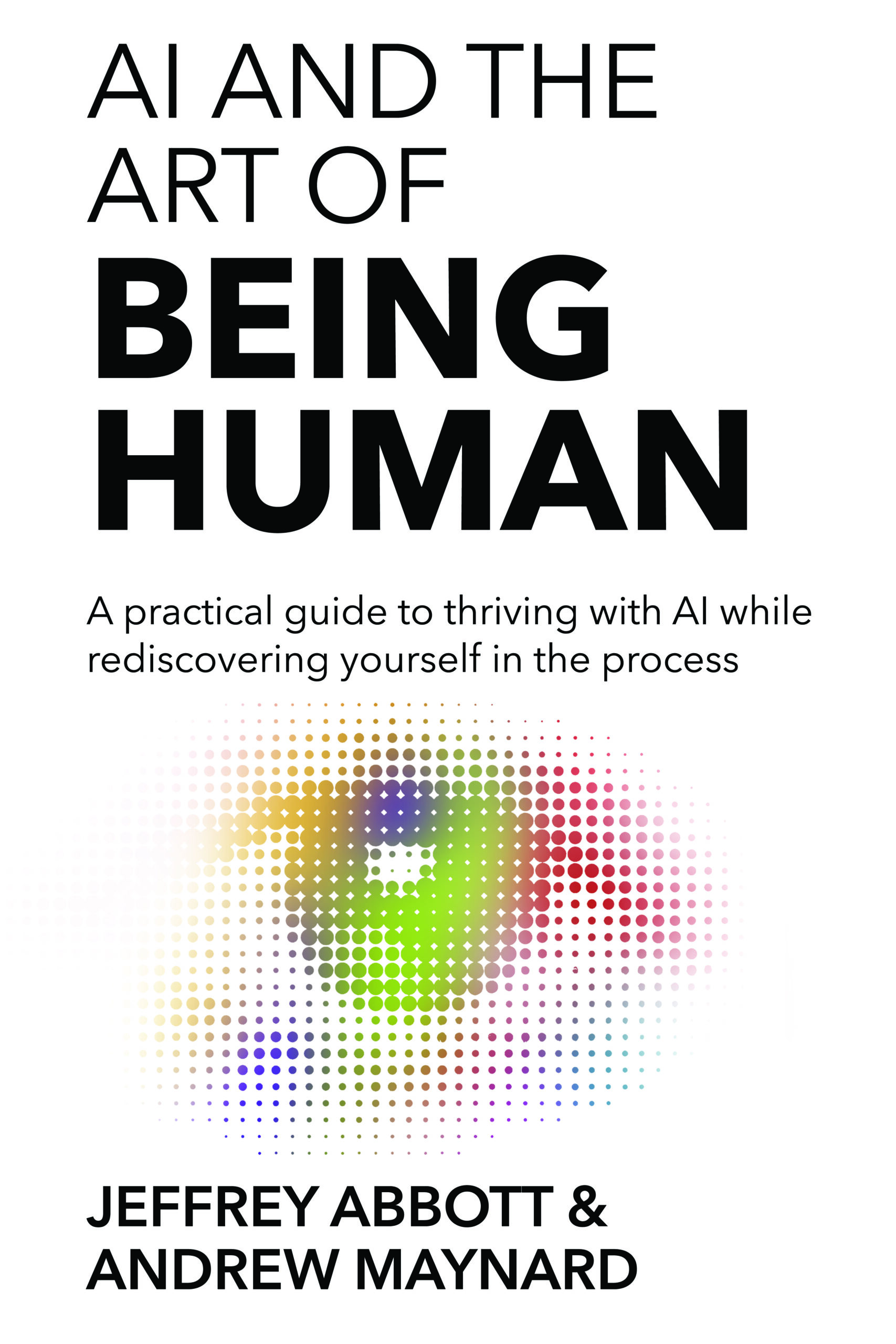
AI and the Art of Being Human is a practical guide to thriving with AI while staying grounded in what makes us uniquely human. Written by Jeffrey Abbott and me, it offers 21 practical tools — organized around four principles: curiosity, intentionality, clarity, and care — for navigating a world where AI can increasingly do what we once thought only humans could. The book uses fictional narratives set across the globe to make these ideas lived and felt, not just understood.
Who is this book for?
Anyone navigating life in a world increasingly shaped by AI. We wrote it for a wide audience — professionals, entrepreneurs, investors, parents, artists, educators, students, and anyone asking “what’s still mine in an age of AI?” The tools are designed to be relevant regardless of your background or technical knowledge.
How is this different from other AI books?
Most AI books focus on what the technology can do, where it’s heading, or what risks it poses. This one focuses on you — your agency, your identity, your meaning — in the face of AI’s growing capabilities. It’s also distinctive in two ways: it uses fictional narratives (27 characters across 13 chapters) to explore ideas in ways that nonfiction alone can’t achieve, and it provides 21 concrete, hands-on tools you can use immediately. It’s not about surviving AI or fearing it. It’s about thriving alongside it.
What are the 21 tools?
They’re practical frameworks organized in four parts. Part I covers foundational mindsets (including the Mirror Test for when AI knows you too well, the Intent Map for making values visible, and the Human Qualities Spectrum for understanding what remains irreducibly human). Part II helps navigate identity and values under pressure. Part III covers creative partnership and organizational care. Part IV focuses on building personal roadmaps and communities. Each tool emerged from a fictional narrative that shows it in action. Full details are here, and downloadable versions are available at aiandtheartofbeinghuman.com/the-tools.
What are the four principles?
The book’s philosophical backbone: Curiosity (staying open and willing to be surprised), Intentionality (choosing consciously rather than following algorithmic momentum), Clarity (seeing what AI misses — the human context beneath the data), and Care (choosing human flourishing over pure optimization). They appear together on the Pocket Card and thread through every chapter.
Why fictional narratives? Why not case studies?
Because the frontier of AI is so new and fast-moving that the real-world case studies most people rely on don’t yet exist — at least not at the depth needed. Fiction lets us explore not just what is, but what could be. Readers see themselves in characters like Elena (a Munich founder whose AI completes her most private thoughts), Sana (a Cairo journalist staring at a deepfake worth millions), or Wei Lin (a fifteen-year-old whose AI portrait is “better” than his own). The stories create understanding that purely analytical writing can’t.
Was this book written with AI?
Yes, deliberately and transparently. Jeff and I made a strategic decision to work closely with AI — Anthropic’s Claude — throughout the development process. This wasn’t an attempt to generate a quick AI book. It was months of methodical work exploring how we could write with AI, and in the process reveal more about the art of being human than we could achieve alone. Every idea, tool, and insight has our human stamp on it. We write about this process in the book.
What is the AI Companion?
It’s a downloadable file (about 78,000 words) that turns your AI assistant into a thinking partner for exploring the book. Upload it to Claude, Gemini, or Grok, and you can have a conversation about the book’s ideas, characters, and tools tailored to your specific questions and situation. It’s free to share under a Creative Commons license. Available at aiandtheartofbeinghuman.com.
What’s the difference between the full edition and the Pocket Edition?
The Pocket Edition captures the essentials — the same stories, characters, and all 21 tools — in a streamlined, portable format (4.25″ × 7″). It removes the sidebars, hands-on cards, footnotes, and longer background passages from the full edition, and adds a Tool Finder and Quick Reference Guide. Designed to be well-thumbed, spine-cracked, and coffee-stained.
Can I use this book in my classroom or organization?
Absolutely. We designed it with educational and organizational use in mind. There’s an Instructor’s Guide for educators, and the tools translate directly to workshop and professional development settings. See the For Educators page for more.
Where can I get the book?
Both editions are available on Amazon, Barnes & Noble, Thriftbooks, and wherever books are sold. You can also download a free preview of the first 50 pages at aiandtheartofbeinghuman.com.
Who is Andrew Maynard?
I’m a scientist, author, and Professor of Advanced Technology Transitions at Arizona State University. I’m the founding director of the Future of Being Human initiative and have spent over two decades studying how emerging technologies reshape society — from federal nanotechnology programs to World Economic Forum Global Agenda councils. I write about these ideas weekly in my newsletter The Future of Being Human and co-host the Modem Futura podcast with futurist Sean Leahy. Previous books include Films from the Future and Future Rising.
Who is Jeffrey Abbott?
Jeff is a founding partner of Blitzscaling Ventures (backed by Reid Hoffman) and founder of AI Salon, a global community spanning 60+ cities that hosts hundreds of events annually. His firm has invested in companies like CrewAI and the AI upskilling platform Multiverse. He bridges Silicon Valley innovation with human-centered values — managing AI investments at a venture capital firm while simultaneously building one of the world’s largest AI practitioner networks.