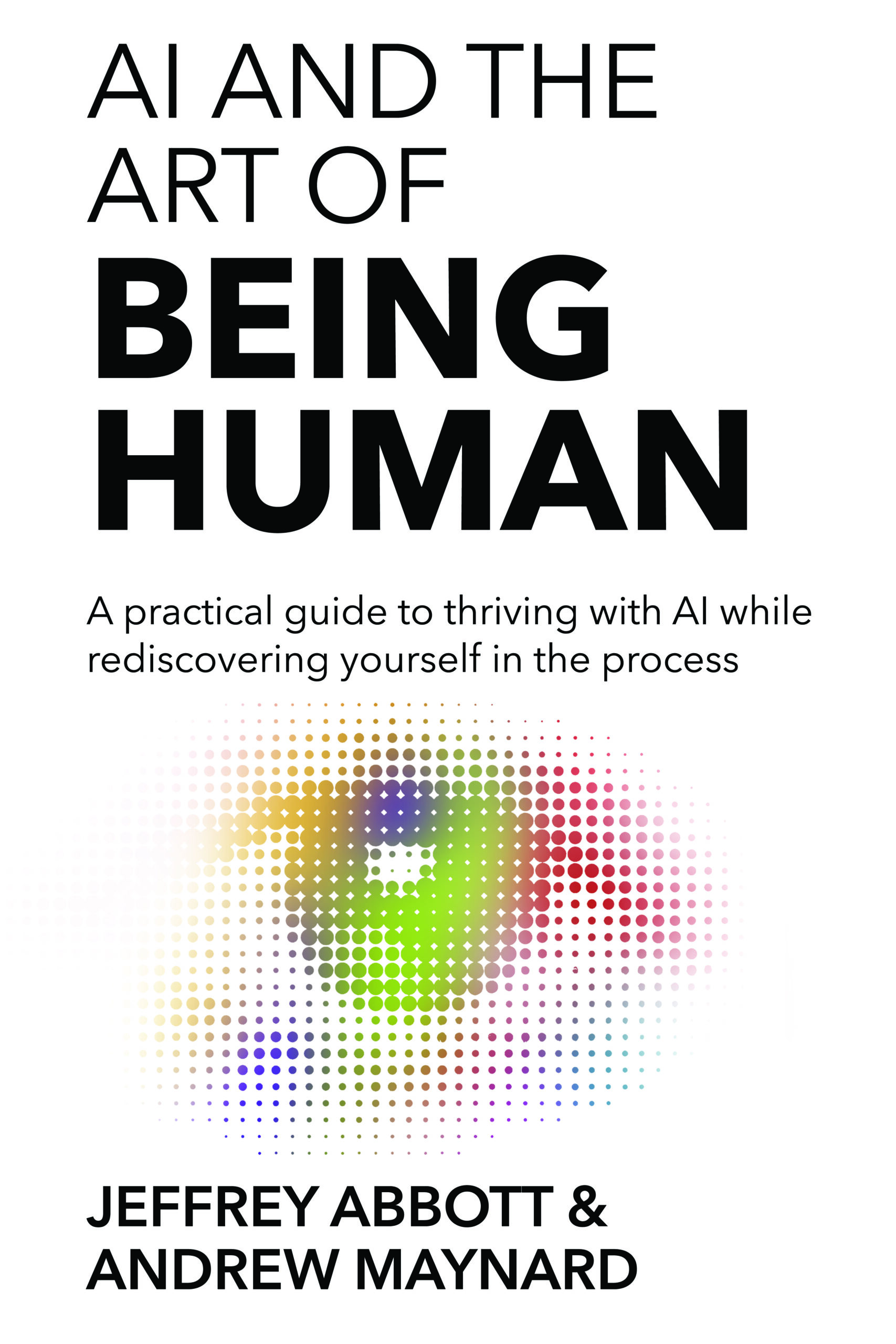
AI and the Art of Being Human
A practical guide to thriving with AI while rediscovering yourself in the process
“In AI and the Art of Being Human, Abbott and Maynard guide you step by step through embracing your humanity as machines become increasingly able to mirror everything you do. Using fictional narratives, they reveal truths about our relationship with AI—and how to thrive in an AI future—that only stories can capture, showing rather than telling what becomes possible when technology reflects who we are. Combined with twenty-one practical tools you can use immediately, their unique approach powerfully transforms abstract AI concepts into lived experience.“
Unlike many AI books that focus on transformative capabilities, future speculation, or emerging risks, AI and the Art of Being Human centers on human agency, meaning, and care in the present. A unique guide to being human—and thriving—in an age of AI, the book offers a practical framework—centered on 21 tools—for understanding what it means to be human in an age of artificial intelligence and for acting on that understanding in everyday life.
Inside, you’ll discover:
- Four guiding principles to help you resist easy AI-generated answers, act with purpose, see beneath the data, and prioritize human flourishing.
- Twenty-one practical tools you can apply immediately in your work and life.
- Fictional narratives that transform abstract ideas into future possibilities.
Also Available: AI and the Art of Being Human: The Pocket Edition
“A profoundly human book on one of the defining questions of our time”
—Thupten Jinpa, Translator to the Dalai Lama
“Not just a vision of a future of people and technology working together, but a roadmap to get there.”
—Jeffrey Pfeffer, Professor of Organizational Behavior, Stanford Graduate School of Business, and author of 7 Rules of Power
“At once engaging and practical, the authors have furnished a road map for the new world.”
—Euan Blair, CEO and Founder, Multiverse
Note from the Author: Why we wrote this book
AI and the Art of Being Human started life as a series of conversations between myself and my co-author Jeff Abbott. Jeff is co-founder of the the VC firm Blitzscaling Ventures and founder of AI Salon—a global network of AI founders and stratups. And so on the surface, not an obvious collaborator with an academic known for grappling with ensuring human thrivig in the face of transformative, and potentially highly disruptive, technologies. And yet we quickly found a common purpose: Given the unique challenges and opportunities presented by AI—especialy given its profound ability to replicate and excel in areas prevously though to be uniquely human—we were interested in finding a way to provide people with a practical toolkit and the insights they need to thrive in this coming age of AI; one that is human-centered, that empowers people to embrace what makes them uniquely them, and that is relevant to anyone striving to navigate AI, irrespective of who they are or what their background is.
Our conversations rapidly turned to the idea of writing a practical guide together. And in the early Summer of 2025 we started work on this in earnest.
Our vision here was clear. This had to be a guide that was tools-base and which provided readers with a practical, hands-on guide to thriving in an age of AI. It had to resonate with tech founders, leaders, and executives, but it also had to be relevant to students, parents, and pretty much anyone trying to make sense of their lives as AI becomes increasingly ubiquitous. And it had to have global relevance and appeal—especially as Jeff’s AI Salon network spans continents.
It also had to be written and published fast. Given the pace with which AI is emerging as a transformative technology, we were deeply aware of a growing chasm between the questions people were seeking answers to and the resources available to them.
Given this vision, we made a bold decision to work closely with AI—Anthropic’s Claude in this case—as we drafted the book. This was not a fly by night attempt to publish an AI-generated book, but a deeply strategic and intentional approach to capturing our expertise, ideas and vision in something that would connect with users and empower them at scale, while simultaneously practicing what we were advocating.
The result was a book which, we believe, is unique in how it both takes users on a journey into thriving in an age of AI, and provides practical, hands-on guidance on how to achieve this.
At the heart of the book are 21 practical tools that range from guiding decisions around developing and using AI apps, to mapping out where AI can excel in supporting your aims versus leaning into what makes you uniquely you, to supporting strategies for effective and human-centric AI. These are intentionally designed to be straight forward to use, easy to incorporate into busy schedules, and relevant to anyone, irrespective of where they live, who they are, and what they do.
How we develop these tools and demonstate their usefulness in the book though is somewhat unique. Rather than using real-world cases or academic studies—because the frontier of AI is so new and fast-moving that these don’t yet exist—we use fictional narratives. Stories, in other words.
These narratives draw on age-old practices of revealing transformative possibilities through storytelling. It’s a practice that works because readers are able to see themselves in the stories and understand how the emerging insights and tools are relevant to them in ways that real-world examples simply cannot achieve.
The end product is a book that is, we believe, highly engaging, deeply insightful, and potentially transformative in how it empowers readers to take control of their relationship with AI and thrive in the world we are building together.
Andrew Maynard
Resources:
The following resources provide deeper insight into the ideas, tools, and structure of AI and the Art of Being Human, including practical materials you can use immediately.
Further details about the book, including downloadable tools, a free preview of the first 50 pages, and additional companion materials:
Download a copy of the AI-legible Instructor’s Guide to AI and the Art of being Human — designed as an AI aid for developing learning and educational content from courses and workshops to professional development resources.
A conceptual overview of the core framework in AI and the Art of Being Human, explaining how the 21 tools support human agency, meaning, and care in an age of AI.
Direct access to all 21 practical tools at the heart of the book, designed for personal, organizational, and educational use.
An unpublished foreword offering additional context on the purpose and origins of the book.